
FAQs

We're here to help.

If you have a question about our heaters or are unsure how to heat your outdoor space just pick up the phone or send us a message. Some questions we get more than others, for these we have compiled our list of frequenetly asked questions below.

Shop now

Frequent Questions

What size Kelray heater do I need?

The right heater depends mainly on the size of the area you want to heat, the mounting height, and how open or enclosed the space is.

As infrared heat warms people and surfaces directly, rather than heating the surrounding air, the position of the heater is just as important as its power output.

Our Heater Selection Wizard is a great place to start. If you’re still unsure, send us the dimensions of your space, your approximate mounting height, and a photo or drawing if you have one. We’re always happy to help recommend the best setup.

How many heaters will I need?

It depends on the size and shape of the area you want to heat.

A smaller seating or dining area may only need one heater, while a larger patio or commercial space may benefit from several heaters positioned to provide even coverage.

Rather than trying to heat an entire outdoor area, we generally recommend focusing the infrared heat on the areas where people will actually be sitting or standing.

If you send us your dimensions and proposed mounting locations, we can help you work out the best number and placement of heaters.

Can Kelray heaters be wall-mounted, ceiling-mounted or flush-mounted?

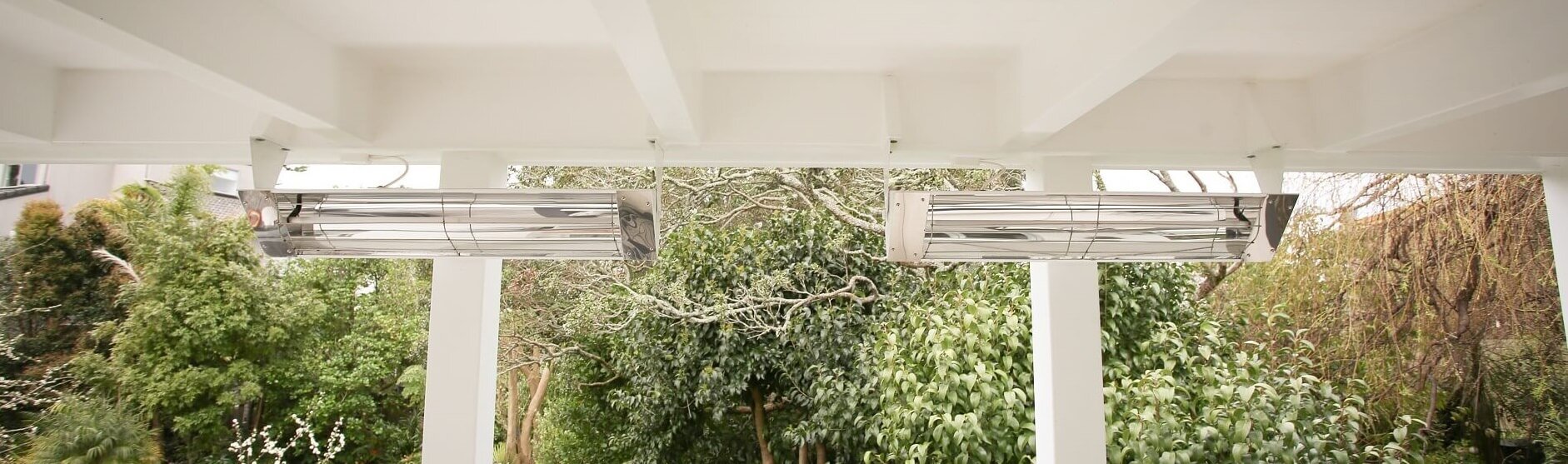
Yes. Kelray heaters can be installed overhead on a ceiling, or wall-mounted and angled toward the area you want to heat.

For a more integrated architectural finish, we also offer flush-mount recess kits that allow selected Kelray heaters to be recessed neatly into a suitable ceiling or overhead structure.

The best mounting method will depend on your space, available height and the area you want to heat.

Can I install my heater vertically or along the slope of my roof?

No. Kelray heaters should be installed with the heater body and quartz element horizontal.

Installing the heater vertically, or allowing the element to run on a slope, can shorten the life of the quartz element and may affect your warranty.

The heater itself can still be angled outward from a wall to direct heat toward the area below — the important thing is that the long axis of the heater remains horizontal.

Can I install a Kelray heater myself?

All Kelray Heaters must be installed by a qualified electrician to ensure safe operation and warranty compliance.

What electrical supply does a Kelray heater require?

Kelray heaters are electric, permanently wired appliances. The electrical requirements depend on the model you select.

Our standard range extends from 2,000W to 8,000W, with electrical loads ranging from approximately 8.3A to 33.4A at 240V. 208V elements are also available for appropriate installations.

Your electrician will need to determine the correct circuit, wiring and protection based on the heater model, installation and local electrical code.

Full electrical specifications for each model are available in our Specifications & Installation Guide.

What is the difference between a single-element and dual-element heater?

Our I-Series heaters use a single quartz element, while our larger ID-Series heaters use two elements.

Dual-element heaters can be wired so the two elements are switched independently. This allows you to operate the heater at half power or full power, depending on how much heat you need.

For example, an ID-60 can provide either approximately 3,000W or the full 6,000W when wired with independent switching.

What are the benefits of infrared heating?

Infrared heating works differently from conventional space heating. Instead of trying to warm the air around you, it sends radiant heat directly toward people and surfaces.

This makes it particularly well suited to patios, decks, restaurants, workshops and other open or partially enclosed spaces.

Benefits include:

  • Instant, directional heat
  • Effective performance in breezy and open areas
  • No open flame or gas bottles
  • No combustion emissions at the heater
  • Quiet operation with no fans or moving air
  • Low maintenance
  • Simple electric operation
  • A comfortable, natural radiant warmth
What does infrared heat feel like?

Infrared heat feels similar to the warmth you feel from sunlight.

Think about standing outside on a cool day. You can feel noticeably warmer when the sun is shining directly on you, even though the surrounding air temperature hasn’t changed.

Kelray heaters work on the same principle, directing radiant energy toward people and surfaces rather than trying to heat all of the air around them.

Do infrared heaters work in windy or open areas?

Yes — this is one of the major advantages of infrared heating.

Traditional convection heaters rely on warming the surrounding air, which can quickly be carried away by wind. Infrared heat travels directly from the heater to people and surfaces, so it remains effective in breezy and partially open environments.

Very exposed spaces may require more power or additional heaters, which is why heater positioning and mounting height are important.

Are Kelray heaters waterproof? Can they be exposed to rain or snow?

Kelray heaters are IPX4 rated, meaning they are designed to withstand splashing water from any direction and are suitable for outdoor installations.

They are also constructed using marine-grade materials specifically chosen to withstand demanding outdoor environments.

However, IPX4 does not mean the heater is designed for immersion or high-pressure water. Where possible, installing the heater beneath some overhead protection will reduce exposure and help keep it looking its best over the long term.

Why are Kelray heaters made from 316 marine-grade stainless steel?

Outdoor heaters live in a tough environment. Rain, humidity, condensation, snow and salt air can all accelerate corrosion — particularly around fasteners, brackets and other small components.

Kelray heaters are built using 316 marine-grade stainless steel, including the small components that are often overlooked.

316 stainless steel offers greater resistance to corrosion than the 304 stainless commonly used in outdoor products, particularly in coastal and high-chloride environments.

It costs us more to build a heater this way, but we believe an outdoor heater should be built to stay outdoors for years — not seasons.

Can Kelray heaters be used in commercial or industrial spaces?

Absolutely.

Kelray heaters are used in homes as well as restaurants, cafés, hotels, resorts, workshops, warehouses and other commercial environments.

Because infrared heat can be directed toward specific areas, it is particularly useful for zoned heating — heating the people or work areas that need warmth rather than trying to heat an entire large space.

Are Kelray heaters portable?

Kelray heaters are designed for fixed installation and are not portable. Each one comes with mounting brackets for easy installation on a wall or ceiling.

For a more seamless look, we also offer flush-mounting options that allow the heater to sit cleanly within your ceiling space.

How do I clean a Kelray heater?

First things first—make sure the heater is turned off and has had time to cool down completely.

Take off the front grille, then gently wipe the reflector using a soft cloth with water or glass cleaner. Just be extra careful around the quartz glass element—it’s delicate!

Let everything dry thoroughly before turning the power back on, and don’t forget to pop the grille back in place when you’re done.

We suggest giving your heater a clean every 3 months, or more often if you’re right by the beach.

How do I estimate the cost of operating an infrared heater?

Electric heaters are economical to operate. It is easy to estimate your operating cost by multiplying the total kilowatts by your local power rate for a “kilowatt hour” (kwh). Standard power rates vary from market to market. Your rate should appear on any monthly utility statement. For example, a typical 3,000 watt (3 KW) heater, at full power, would cost 39 cents per hour based on a utility rate of 13c per kwh.

For comparison, and this will vary from market to market, most mushroom top style propane heaters run at 40,000BTU's, and a standard propane bottle will last around 10-11 hour, and cost approximately $2.80 per hour to run (assuming a $30 bottle swap or replacement).


Also keep in mind that your electric heater has a lower acquisition cost and lower ongoing maintenance costs than a standard gas heater.

How long can I expect my element to last?

Our quartz elements generally last for between 7,000 and 10,000 hours depending on the type of use. So you may enjoy your heater for years before a replacement would be needed.

Where are Kelray Heaters Made?

Designed and manufactured in New Zealand, with final assembly, sales and support for North America from Kelray Heating Canada in British Columbia.

What kind of warranty do Kelray Heaters have?

Kelray Heaters carry a 5 year warranty

Are Kelray infrared heaters short-, medium- or long-wave?

Kelray Heaters are medium wave – the safest and the most reliable wavelength for heating

When will I receive my order?

We build each heater to order, and ship within 2 weeks for receiving your confirmed order.